

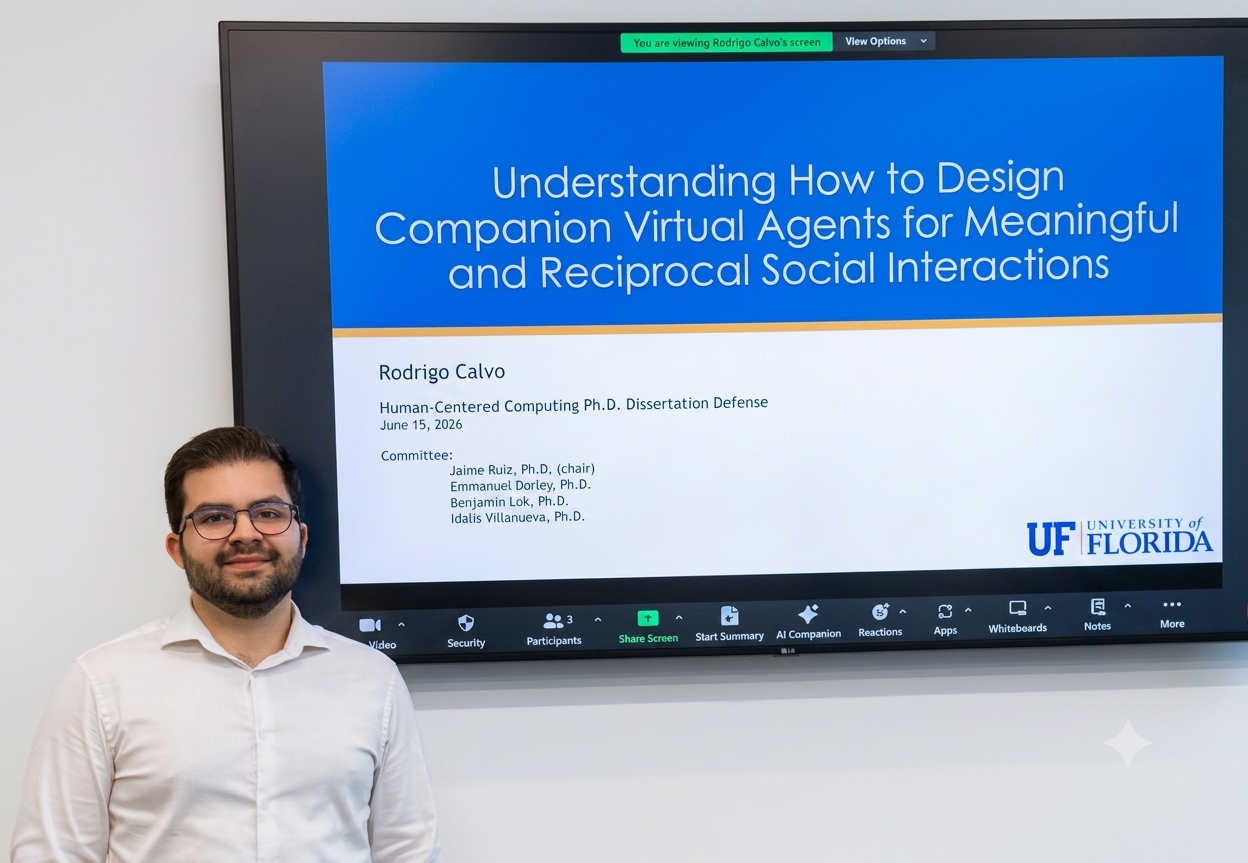
 The lab is proud to congratulate Rodrigo Calvo on the successful defense of his PhD dissertation. Watching a student grow from a curious researcher into an independent scholar is one of the most rewarding parts of the research process, and Rodrigo’s defense marked the culmination of years of rigorous, thoughtful, and genuinely important work.
Rodrigo’s dissertation addresses a timely and consequential problem: as loneliness and social isolation continue to emerge as pressing public health concerns, companion virtual agents (CVAs) have gained increasing attention as a potential means of providing social support and meaningful interaction. Advances in large language models have made these agents more conversationally capable than ever, but as Rodrigo’s work makes clear, capability alone does not guarantee a healthy, trustworthy, or sustainable relationship between people and the agents they talk to.
Across three complementary studies, Rodrigo examined how conversational memory, agent self-disclosure, and social configuration shape the quality of human-CVA relationships:
- Long-term interaction patterns. A seven-day study revealed how users build relationships with a CVA through daily interaction, and identified conversational memory and the agent’s inability to self-disclose as key factors shaping engagement — findings that directly motivated his next two studies.
- Agent self-disclosure. Comparing three levels of CVA self-disclosure, Rodrigo found that while standardized measures showed no significant differences, closer analysis of conversation logs and qualitative feedback told a richer story. Moderate disclosure felt most authentic and elicited the strongest reciprocity, while high disclosure backfired: an “authenticity paradox” in which oversharing exposed the agent’s artificiality rather than deepening the connection.
- Single-agent vs. multi-agent design. Comparing a single companion agent to a multi-agent condition with three role-differentiated agents, Rodrigo found that the single-agent condition felt more personal and trustworthy, while the multi-agent condition increased negative affect and frustration, without any corresponding increase in mental workload. In other words, the cost of multi-agent interaction was relational rather than cognitive, and role differentiation carries real design risk in companionship contexts.
Together, these studies offer theoretical insight, empirical evidence, and practical guidelines for designing companion agents that foster reciprocal, meaningful, and socially intelligent interactions — contributions with implications ranging from mental health support to everyday social companionship.
The lab is also delighted to share that Rodrigo will be joining Weber State University in Utah as an instructor. It’s a wonderful next step, and we have no doubt his students will benefit from both his expertise and his genuine care for good research and good teaching.
Congratulations, Dr. Calvo. This achievement was well earned, and we look forward to seeing where your research takes you next.